Is the SnnyPet ZY-245 compatible with wet food or canned pates?
- No. The ZY-245 is precision-engineered exclusively for dry kibble (5-15mm). Using wet food or pates will stick to the rotating blades, causing the mechanism to jam and the motor to potentially overheat.

⚠️ Pro Tip: To prevent clogging and ensure the longevity of your ZY-245, only use high-quality dry kibble between 5mm and 16mm. Never use wet food, canned food, or raw meat as they will damage the internal motor.
Can I put raw meat in the feeder if my pet is on a fresh diet?
- We strongly advise against it. Raw meat spoils quickly in the 6L hopper, creating a high risk of bacterial growth and cross-contamination. This not only endangers your pet’s health but also leads to foul odors and hardware damage.
How can I use the ZY-245 if my pet requires mixed feeding?
- Use a hybrid approach: set the ZY-245 for automated dry meals throughout the day, and manually serve wet food separately in a stainless steel bowl. This maintains your pet’s routine while keeping the smart device hygienic.
What is the difference between the wide-angle and macro-lens on the ZY-245?
- The dual-HD system features a top wide-angle lens for full-room monitoring and a dedicated downward macro-lens for the bowl. This “split-view” prevents the visual distortion common in single-lens feeders.
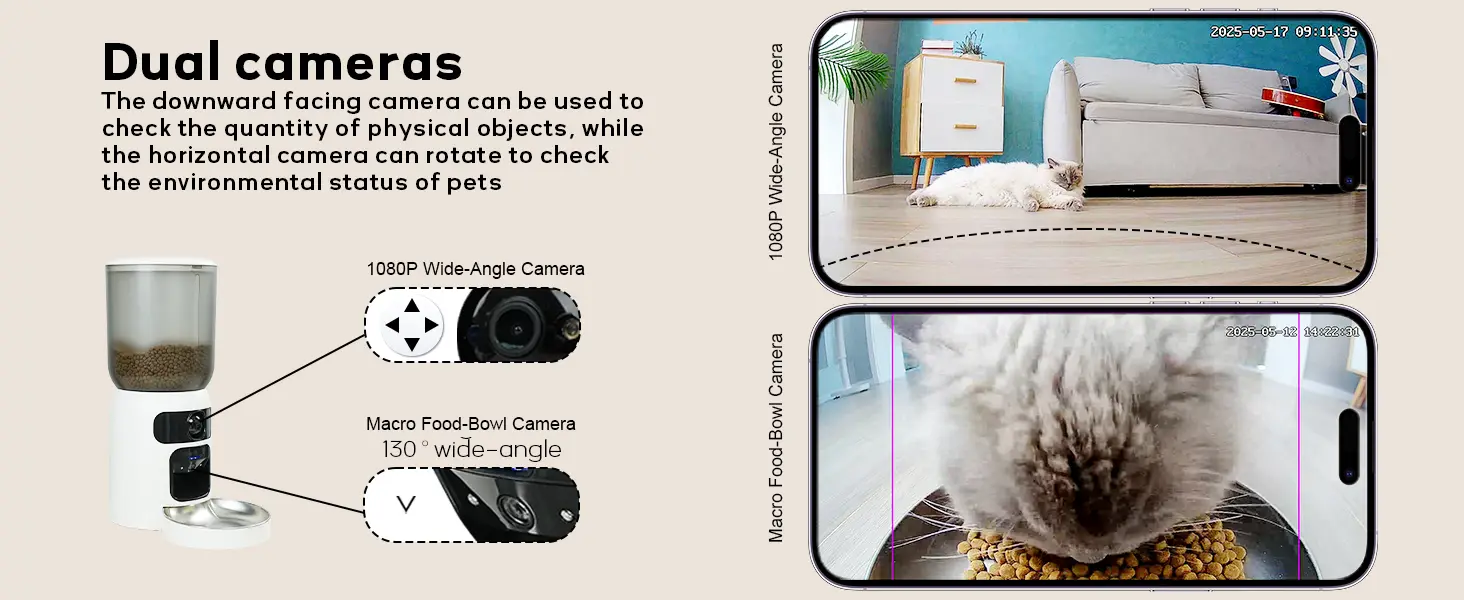
Monitor from Anywhere: Our App provides a seamless dual-camera experience. Use the 1080P Wide-Angle lens to check on your pet’s activity, and the Macro Feeder Cam to ensure their bowl is full and fresh.
Can I confirm if my pet actually finished their meal remotely?
- Yes. By switching to the Bowl View in the app, you can see a crisp, close-up image of the feeding area to verify successful dispensing and check for any leftovers or skipped meals.
Can I control the built-in laser toy from my office?
- Yes, the laser is fully integrated into the iCam365 App. You can manually guide the dot to play with your pet in real-time, providing essential cardio exercise while you are away from home.
Is the laser toy safe for unsupervised play?
- The laser is for manual interaction only. We intentionally omitted “auto-play” to prevent pets from overexertion or developing obsessive habits. We recommend ending play sessions with a physical treat.
How long will the 6L food hopper last for an average cat?
- A full 6L tank (approx. 2.5kg) typically lasts an average cat for 30 days. This makes it an ideal solution for long business trips or vacations without needing a pet sitter for every meal.
Is the ZY-245 capacity sufficient for medium or large dogs?
- For medium dogs, it lasts about 10-15 days. For large breeds, while the capacity is ample, we recommend checking if your kibble exceeds the 16mm size limit to ensure smooth dispensing.
What is the maximum kibble size the ZY-245 can dispense?
- The device supports dry kibble with a diameter between 5mm and 15mm. Using oversized treats or irregular large-breed kibble may jam the internal rotor and stop meal delivery.
Does the feeder work with heart-shaped or triangular kibble?
- Yes, as long as the pieces fit within the 15mm specification, the rotating blade design is capable of handling various shapes, including round, square, and triangular dry food.
How does SnnyPet prevent kibble from getting stale?
- We use an Airtight Silicone Seal and a secure twist-lock lid. Combined with a replaceable desiccant box, this system minimizes oxidation and keeps food crisp and nutritionally intact for weeks
Will the ZY-245 protect the food from ants and pests?
- The 360° sealed structure and anti-clogging outlet create a physical barrier that is extremely effective at preventing ants and other insects from reaching the food storage area.
Does the ZY-245 have a jam-prevention mechanism?
- Yes. The feeder uses a high-torque motor and flexible silicone impellers designed to handle slight variations in food size within the 5-15mm range. To prevent jams, we recommend using only dry kibble that meets the size specification.
Can I mix freeze-dried pieces with my dry kibble?
- Yes, provided the freeze-dried pieces are under 15mm. Mixing small amounts of dry toppers is safe and will not clog the mechanism in most scenarios.
Are there any hidden activation fees for the G761 tracker?
- None for the hardware and the Tlife app service. The G761 is a one-time purchase with $0 monthly subscription fees for using our app. However, the device requires a standard Nano SIM card with a data plan from a local carrier to transmit location data.
Are there any monthly subscription fees for SnnyPet tracking?
- No subscription fees. Unlike other trackers that force you into expensive monthly service plans, SnnyPet offers a “Subscription-Free” model. You simply use a local IoT or SIM card of your choice. You only pay for the actual data consumed at your local carrier’s rates—typically just a few dollars a month—while our App services remain completely free to use.
How accurate is the GPS signal inside houses or near tall buildings?
- Indoors, the device uses Wi-Fi and cellular base station (LBS) positioning for approximate locations, which has a larger error margin. Outdoors, it uses a hybrid GPS and cellular system. Near tall buildings, accuracy can be affected, typically with a margin of 5-20 meters.
What is GPS drift, and how does SnnyPet manage it?
- GPS drift is a common satellite error. Our firmware uses advanced filtering algorithms to distinguish between “phantom movements” and your pet actually leaving the safe zone, reducing false alarms.
Why is the G761 better than an AirTag for a lost dog?
- AirTags rely on nearby iPhones. If your pet is in a forest or rural area with no people around, an AirTag cannot update its location. The G761 uses satellites to find your pet anywhere, independently.
Does an AirTag provide live movement tracking?
- No. AirTags give intermittent “last seen” snapshots. The G761 provides a live path on the map, allowing you to see exactly where your pet is heading in real-time.
Is the G761 too heavy for a Chihuahua or Yorkie?
- The G761 is ultralight at 38.6g. While it fits most small dogs (15 lbs+), ensure the collar is adjusted snugly to prevent the device from swinging or impeding their movement.
Can I use the dog GPS tracker on my cat?
- Technically yes, but we recommend it primarily for dogs. Cats have different neck anatomy; for a cat, ensure the collar has a breakaway feature for safety if it gets caught on a branch.
Does the G761 work in remote mountains with no cell service?
- The G761 will continue to receive GPS satellite signals and record your pet’s location coordinates in its internal memory, even without cell service. However, you will not be able to see the location on your app’s map in real-time. Once your pet returns to an area with cellular coverage, the device will sync the recorded path to the app.
What happens to the tracking data if the signal is lost?
- The G761 has internal storage. If cellular signal is lost, the device continues to log GPS coordinates internally. Once the device re-enters an area with signal, it will automatically upload the stored historical path to the app, so you won’t lose the tracking information.
Do veterinarians recommend using the SnnyPet Q12?
- Vets generally prefer vibration-based correction over static shock. The Q12 is considered a humane “interruption tool” that helps with behavior redirection without damaging the bond between owner and pet.
Will this collar fix barking forever?
The Q12 is a training aid. It stops nuisance barking while worn, but for permanent results, it should be paired with positive reinforcement training to address the root cause of the barking.
Can an Apple AirTag replace a dedicated GPS dog tracker for pet safety?
While AirTags are efficient for finding keys, they rely on the Bluetooth “Find My” network of nearby devices. In rural or low-traffic areas, they often fail. A dedicated GPS tracker, such as the G761, uses multi-mode GNSS for real-time independence and precision anywhere.
Why do some pet tech brands charge high monthly subscription fees?
Many brands adopt a “razor-and-blade” business model: offering low hardware prices bundled with mandatory monthly “subscription taxes.” This covers cloud storage and cellular data but often maximizes recurring revenue. Our audit favors “Buy-and-Own” models like the G761 to save long-term costs.
What is the difference between LTE-M, 4G, and 2G pet trackers?
LTE-M is the modern standard for IoT, offering deeper signal penetration and significantly better battery life than power-hungry 4G networks or outdated 2G/3G infrastructures used in legacy trackers.
Are microchip-activated smart pet doors worth the investment?
Yes, especially for multi-pet homes or areas with neighborhood animals. These doors audit the unique ID of your pet’s microchip or a smart collar tag to prevent unauthorized entry while ensuring your pet’s freedom.
What should I look for in an AI smart feeder's camera system?
Look for “Zero Blind Spot” dual-lens systems. A single-lens camera cannot monitor both the pet and the food level simultaneously. A dual-lens system like the ZY-245 provides a complete feeding audit for total peace of mind.
How to evaluate the waterproof rating of a smart pet collar?
An IP67 rating ensures the device is dust-tight and can handle 30 minutes in 1 meter of water. For active swimmers, look for IP68-rated devices like the G761 to maintain hardware integrity in all environments.
What is the "Total Cost of Ownership" (TCO) for a pet GPS tracker over 3 years?
TCO = Hardware Price + (Monthly Fee × 36 Months). A cheap tracker with a $12 fee actually costs hundreds more over time. Investing in subscription-free hardware is a more transparent financial audit for pet owners.
Do smart pet water fountains actually improve pet hydration?
High-end fountains with UV-C filtration and constant circulation mimic “living water,” which pets are biologically wired to prefer. This significantly reduces the risk of urinary issues compared to stagnant water bowls.
How does AI facial recognition work in multi-pet smart feeders?
It audits facial features or collar tags to distribute specific portions, ensuring a “bully” pet doesn’t steal a “senior” pet’s prescription diet. This technology is a cornerstone of the ZY-245 system.
Is global shipping for pet tech safe and duty-transparent?
Professional global brands use IOSS and “All-In” pricing to ensure no surprise taxes at the doorstep. Always audit the shipping policy for “Duties Included” status to ensure a smooth international purchase.
How do I audit the "Signal Penetration" of a GPS pet tracker in dense forests?
Signal integrity in deep cover requires a high-sensitivity antenna. The G761 uses LTE-M technology, which offers superior penetration compared to standard 4G, ensuring a reliable audit of your pet’s location even under heavy canopy.
Is a 5-pound dog too small for a smart bark collar?
Weight is a critical safety audit factor. The Q12 is specifically engineered for micro and small breeds weighing between 5 and 18 lbs, ensuring the hardware ergonomics match the delicate neck structure of smaller pets.
Why should a smart feeder have "Physical Dual-Lens" instead of digital zoom?
Digital zoom loses detail. A professional audit requires a physical dual-lens system like the ZY-245, where one lens is dedicated to wide-angle pet monitoring and the second is calibrated specifically for macro food-bowl auditing.
What is the risk of using 9V chargers on 5V pet electronics?
Hardware integrity audit: High-voltage chargers can overheat and permanently damage sensitive IoT circuits. For devices like the Q12 , only use a 5V output to prevent internal battery degradation and safety risks.
Does a subscription-free tracker mean lower location accuracy?
Accuracy is determined by the GNSS chip, not the billing model. The G761 utilizes a professional-grade 7-mode GNSS system to provide top-tier precision while auditing $0 in ongoing monthly costs.
Can I use an automatic feeder for large kibble or wet food?
Mechanical reliability audit: Standard AI feeders like the ZY-245 are precision-engineered for dry kibble only. Using wet food or oversized particles can cause jams and compromise the automated feeding audit.
Why is "Throat Vibration" sensing better for bark collars?
Sound-only sensors often misinterpret environmental noise. A dual-sensing audit, found in the Q12 , combines audio with physical throat vibration to ensure the device only responds to the wearer’s bark.
Is a 2.4GHz Wi-Fi connection a limitation for smart pet feeders?
In a signal audit, 2.4GHz is superior for range and wall penetration. The ZY-245 utilizes 2.4GHz to ensure a stable connection across larger homes where 5GHz signals often fail.
How does "Buy-and-Own" hardware impact the resale value of pet tech?
Subscription-linked devices often become “bricks” without an active account. Subscription-free hardware like the G761 maintains higher long-term value because the tracking functionality remains inherent to the device, not the service contract.
Should I look for an AI feeder with internal battery storage?
For a complete reliability audit, yes. The ZY-245 features dual power backup, ensuring the scheduled feeding logic continues during power outages, a standard that single-source feeders fail to meet.
What is the quick setup process for the SnnyPet ZY-245 smart feeder?
Setup takes about 5 minutes: 1. Download the “iCam365” app and create an account. 2. Tap “Add Product” and scan the QR code on the feeder’s bottom. 3. Hold the reset button on the bowl’s side for 3 seconds until the LED blinks. 4. Select your Wi-Fi network and follow the app prompts to finish.
What should I do if my SnnyPet ZY-245 won't connect to Wi-Fi or the network isn't visible?
First, ensure the feeder is plugged into a power outlet, as connection cannot be established on battery power alone. Download and open the iCam 365 app. Make sure the indicator light is flashing blue and you hear the voice prompt.
If the network is not visible:
- Reset the device: Press and hold the WiFi Reset button for 4 seconds until it blinks blue.
- Check Wi-Fi Band: Ensure you are using a 2.4GHz network. If your router uses 5GHz and the device is not compatible, the connection will fail.
- Permissions: Ensure your phone’s Bluetooth, WLAN, and Location Services are all turned on.
How can I track my pet's feeding history on the ZY-245?
- You can view the Feeding Record directly in the iCam 365 app. The app logs every scheduled and manual feeding event in real-time, allowing you to confirm that your pet has been fed successfully even when you are away from home.
Why is there a delay in the feeding record showing up in the iCam 365 app?
- The feeding record is uploaded to the cloud server immediately after the dispensing task is completed. If you don’t see the update, it’s usually due to network latency. Simply pull down to refresh the device page in the iCam 365 app to see the latest logs.
Will changing kibble size affect the portion weight of the ZY-245?
Yes. Since the ZY-245 dispenses food based on the volume of the internal rotor (divided into “copies/portions”), significantly larger or smaller kibble will result in different weights per serving. We recommend weighing the first few portions of any new food and adjusting the number of scheduled servings in the app to maintain a consistent diet.
Will my pet still be fed if the Wi-Fi is down?
- Yes. Once you have set the Timer Feeding schedule in the app, the data is saved locally on the feeder’s chip. The device will continue to dispense meals at the scheduled times even without an internet connection. Please note that you won’t receive app notifications until the Wi-Fi is restored.
What kind of backup batteries do I need?
- The ZY-245 uses 4 x D-cell (No.1) alkaline batteries as a backup power source. In the event of a power outage, the device will automatically switch to battery power to ensure your pet is fed on time.
What do the LED indicator lights on the G761 indicate?
According to the manual: Blue Light Constantly Bright means successfully connected to the network; Blue Light Single Flash means searching for network signal; Green Light Single Flash means searching for GPS signal.
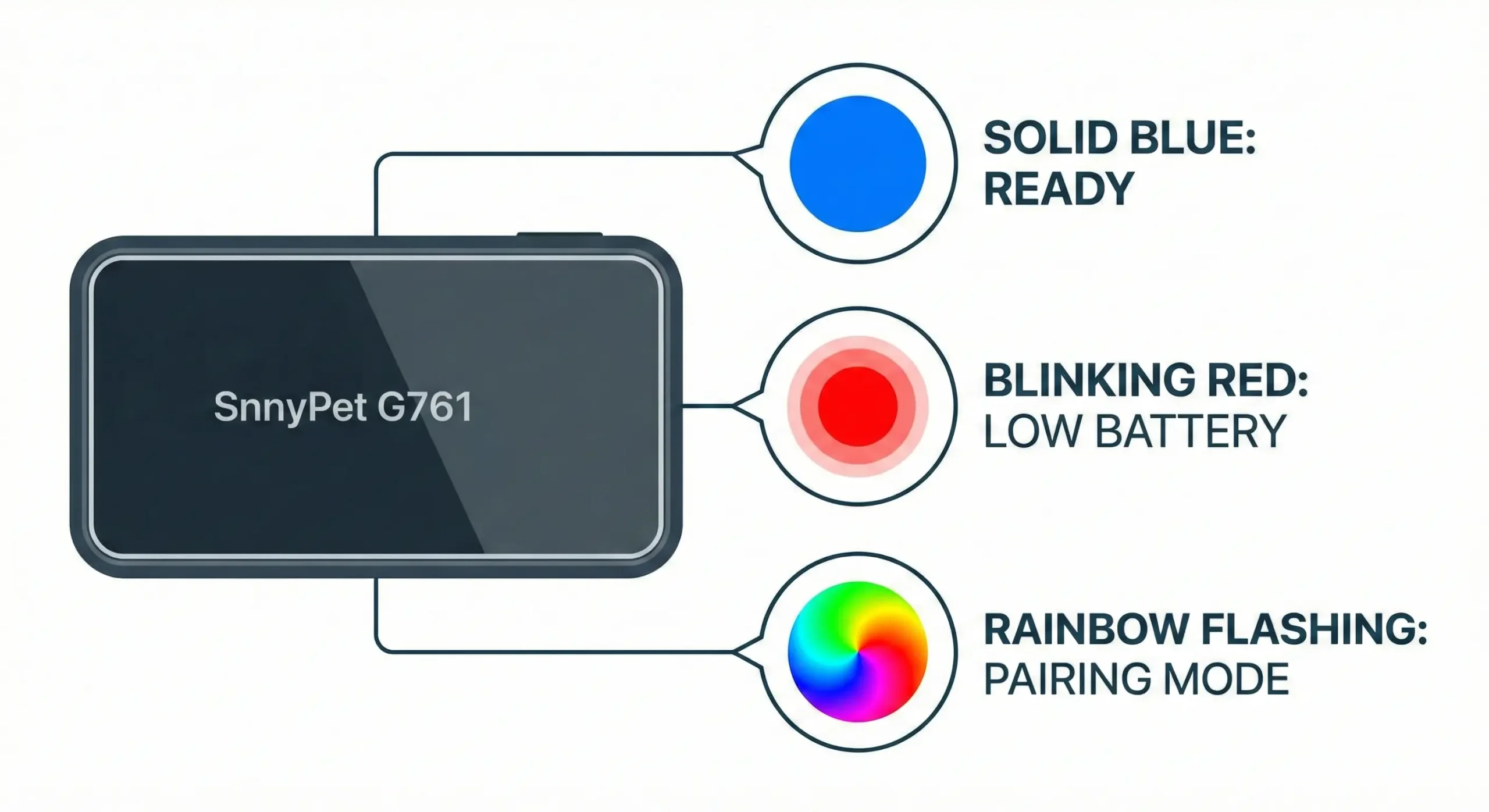
What does the red LED light mean?
Solid Red means the device is currently charging. The light will turn off once the battery is fully charged. Please refer to the Ismate app for specific battery percentage levels.
Can I use the G761 internationally when traveling?
Yes, provided you install a local Nano SIM card that supports the required cellular bands (800/900/1800MHz). The G761 features a physical SIM slot, allowing you to choose a carrier that offers the best coverage in your destination country.
Does the G761 have roaming charges, and what happens if there's no cell coverage?
SnnyPet does not charge roaming fees, but your local SIM carrier might. In areas with no cell coverage, the device cannot transmit real-time data to the app; tracking will resume automatically once a network signal is re-established.
What is the neck circumference range for the G761?
The G761 is designed for pets with a neck circumference between 35cm and 45cm. Please measure your pet’s neck carefully to ensure a secure and comfortable fit.
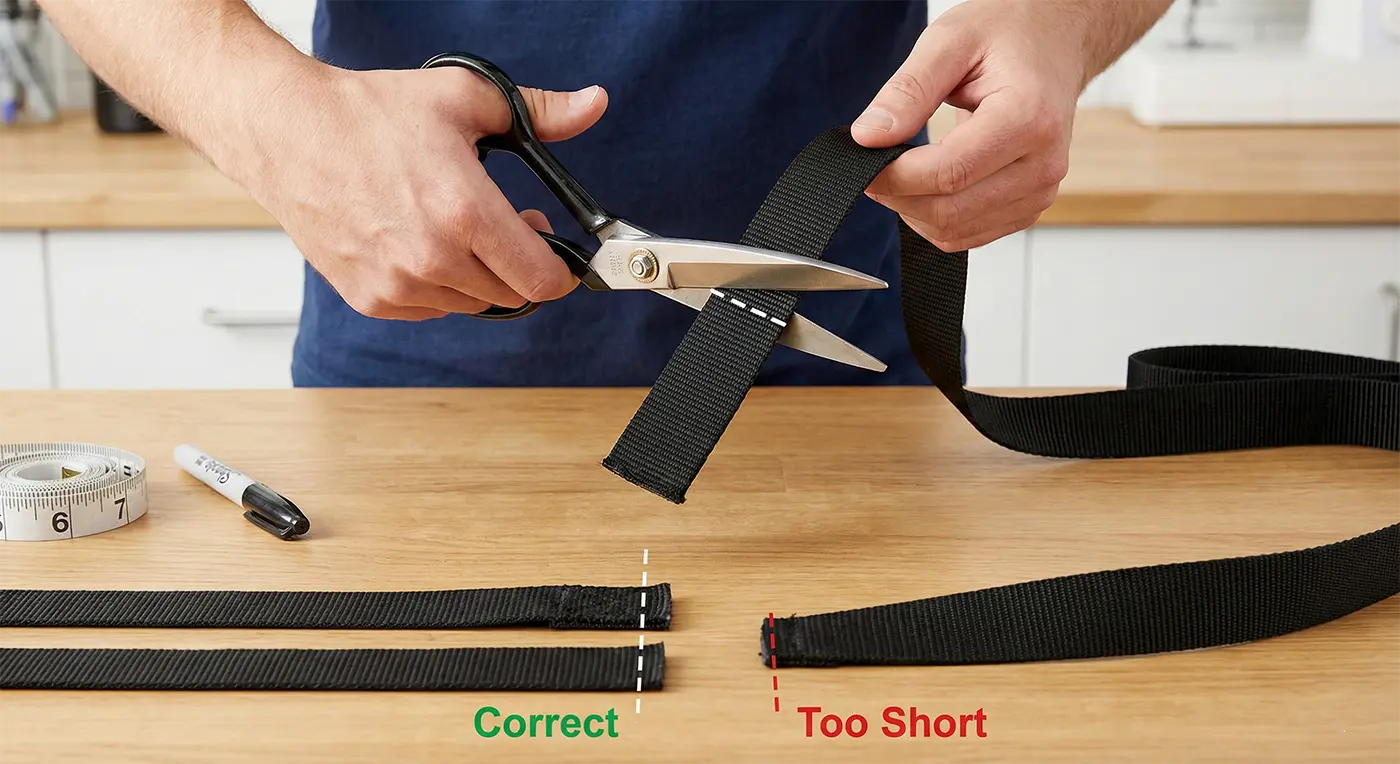
Can I buy a replacement strap if I cut it too short?
Yes, the webbing is removable and replaceable, and spares can be purchased separately. When trimming, be careful not to cut it too short the first time, as you can always trim more later, but you cannot add length back.
How do I perform a factory reset on my G761 tracker?
To reset the device for a new user, you must unbind and delete the tracker from your Tlife App account. Once deleted, the device can be paired with a new account.
What happens to my personal data when I transfer the G761?
When you delete the device from your Tlife app account, all bound data and historical records are cleared from your account. The device is then fully reset and ready to be bound to a new user.
Where is the best position to place the Q12 bark collar on my dog's neck?
Center the device directly on your dog’s throat. As shown in the manual illustrations, the vibration device and microphone sensor must be centered at the front of the neck to accurately detect barking and deliver effective vibration cues.
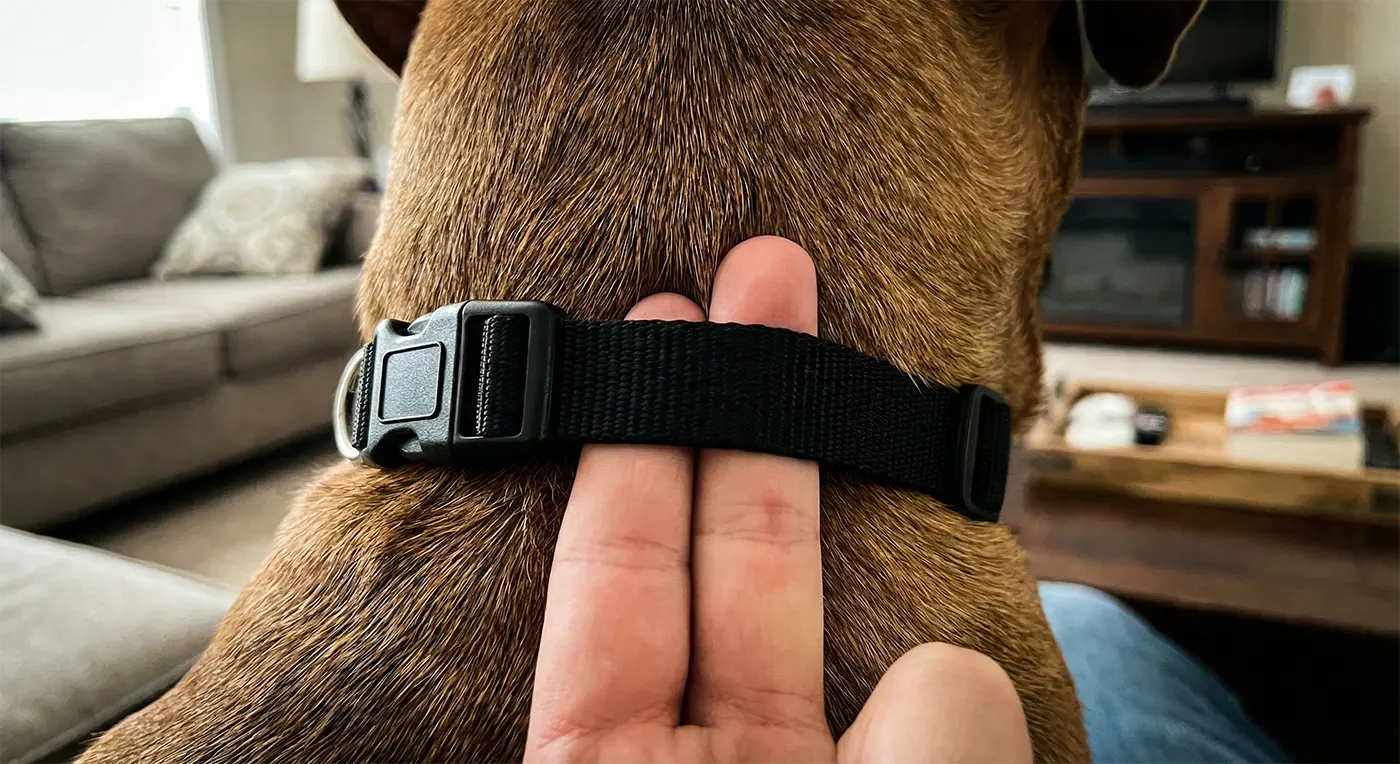
How tight should the Q12 collar be for effective training?
The collar should be snug. According to the manual, it should be loose enough to allow only one finger to fit between the strap and your pet’s neck. A fit that is too loose will prevent the microphone from detecting barks and the vibration from being felt.
Does the Q12 work on dogs with thick fur?
Yes. However, for the best results, the vibration device on the back of the unit needs to be close to the skin. If your dog has an extremely thick coat, you may need to trim the hair in the contact area to ensure the device can accurately detect barking decibels and transmit vibration.
Can my dog wear the Q12 bark collar 24/7?
No. Please do not leave the product on your dog for more than 12 hours. Prolonged wear can lead to skin irritation or rashes due to constant physical pressure on the neck. Check the skin area daily for any signs of sores.
Is it a fire hazard to leave my SnnyPet feeder plugged in while I’m on vacation?
It is completely safe to leave your feeder plugged in continuously, as these devices are designed for 24/7 operation. They include built-in protections like over-current protection, thermal fuses, and flame-retardant materials.
How should I prepare my SnnyPet feeder if I’m leaving for over a month?
For long absences (over 1 month), it is best to completely empty the hopper to prevent food from going stale or attracting pests. If the feeder will not be used during this time, you should unplug it for safety.
My SnnyPet ZY-245 data seems wrong, how do I recalibrate the weight sensor?
Most weight reporting issues can be solved by ensuring the bowl has at least 45 seconds of complete inactivity. If errors persist after a manual refresh in the app, verify that you haven’t switched food brands without updating the “Pet Food Details” section, as different kibble sizes can shift portion weights by up to 3g.
What is the number one cause of hardware failure for SnnyPet collars?
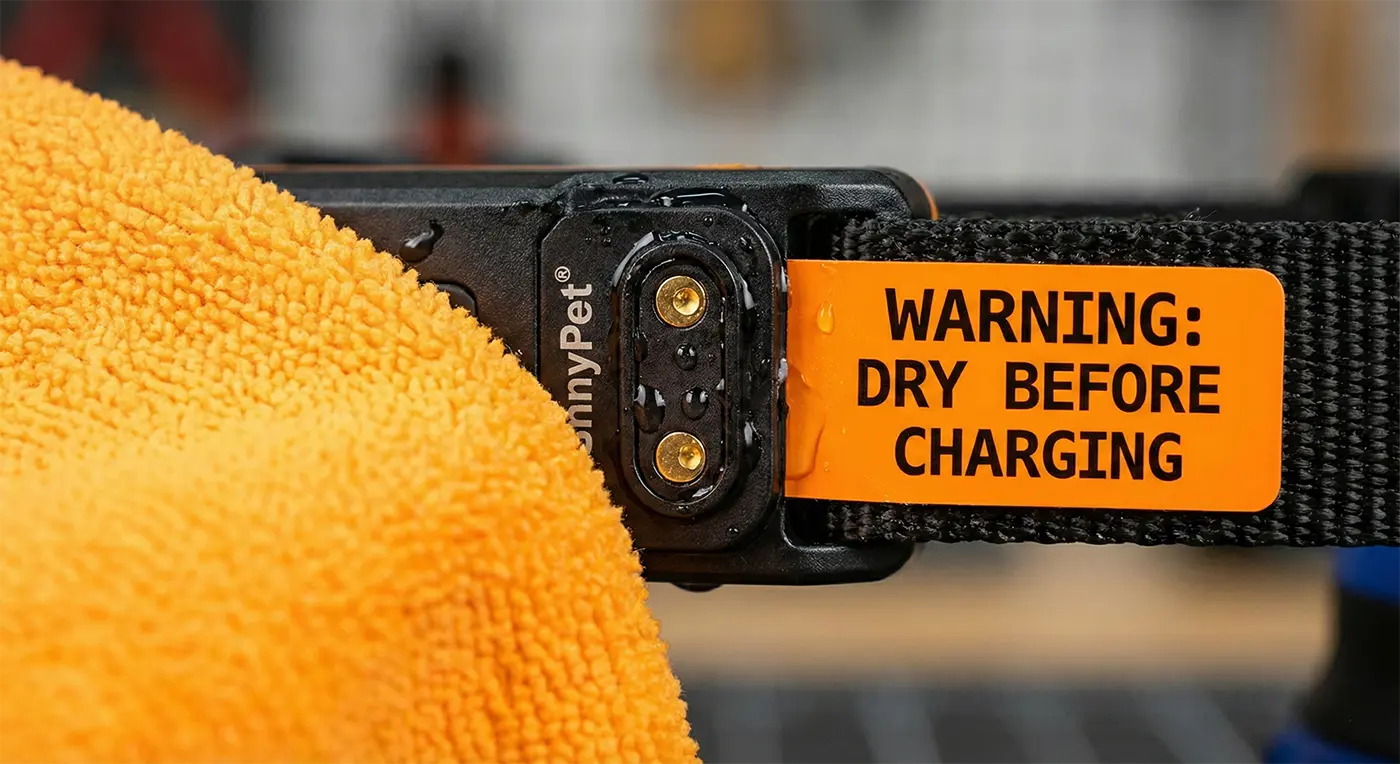
Moisture in the charging port is the primary cause of device failure. Whether it’s the G761 tracker or Q12 collar, the port must be completely dry before connecting the charger. Always shake out excess water, air dry for 30 minutes, or use compressed air after your pet has been in water.
How do I create a virtual fence (geofence) around my house using the SnnyPet G761?
In the Tlife app, select your SnnyPet G761, tap “Safe Zones,” and then “Add Zone.” You can then draw a polygon on the map around your property to define the safe area.
Can I set irregularly shaped safe zones, or must they be circles?
The G761 supports custom polygon shapes. This allows you to draw freeform boundaries that match the exact shape of your backyard or farm, providing much higher precision than traditional circular fences.
Can I set multiple safe zones and choose when to get alerts?
Yes, the Tlife app allows you to manage multiple safe zones (e.g., home and park) simultaneously. You can customize notifications to alert you whenever your pet enters or exits any of these areas.
How do I adjust the location update frequency?
In the Tlife app, you can choose from three preset modes: Normal Mode (updates every 1 minute), Daily Tracking (every 10 minutes), or Power Saving (every 60 minutes). This allows you to balance tracking precision with battery longevity.
Can I get an immediate location update even if my frequency is set to a long interval?
Yes. Regardless of your interval setting, you can always tap the “Locate Now” button in the app for an instant update. Note that there is a 1-5 minute cooldown between manual requests depending on the network.
How does the update frequency affect battery life?
Tracking frequency is the primary factor in battery consumption. Using Normal Mode (1 min) provides the highest precision but consumes more power, while Power Saving mode (60 min) significantly extends the time between charges. We recommend selecting a mode based on your pet’s daily activity level.
Is the Q12 vibration collar effective for deaf dogs to stop barking?
Yes. Since the Q12 uses strong vibration as a deterrent rather than just sound, it is highly effective for deaf dogs. The tactile vibration will interrupt the barking cycle even if the dog cannot hear the warning beep.
Can I use the Q12 to train my dog to come to me?
No. The Q12 is an automatic bark control collar, not a remote training device. It only activates when it detects your dog barking and cannot be triggered manually for recall or command training.
How does the Q12 distinguish between my dog's bark and environmental noise?
The Q12 uses an advanced detection sensor that captures the specific sound frequency and vibration of your dog’s bark. It is designed to filter out most background noises like TV sounds or other dogs, ensuring correction only happens when your pet barks.
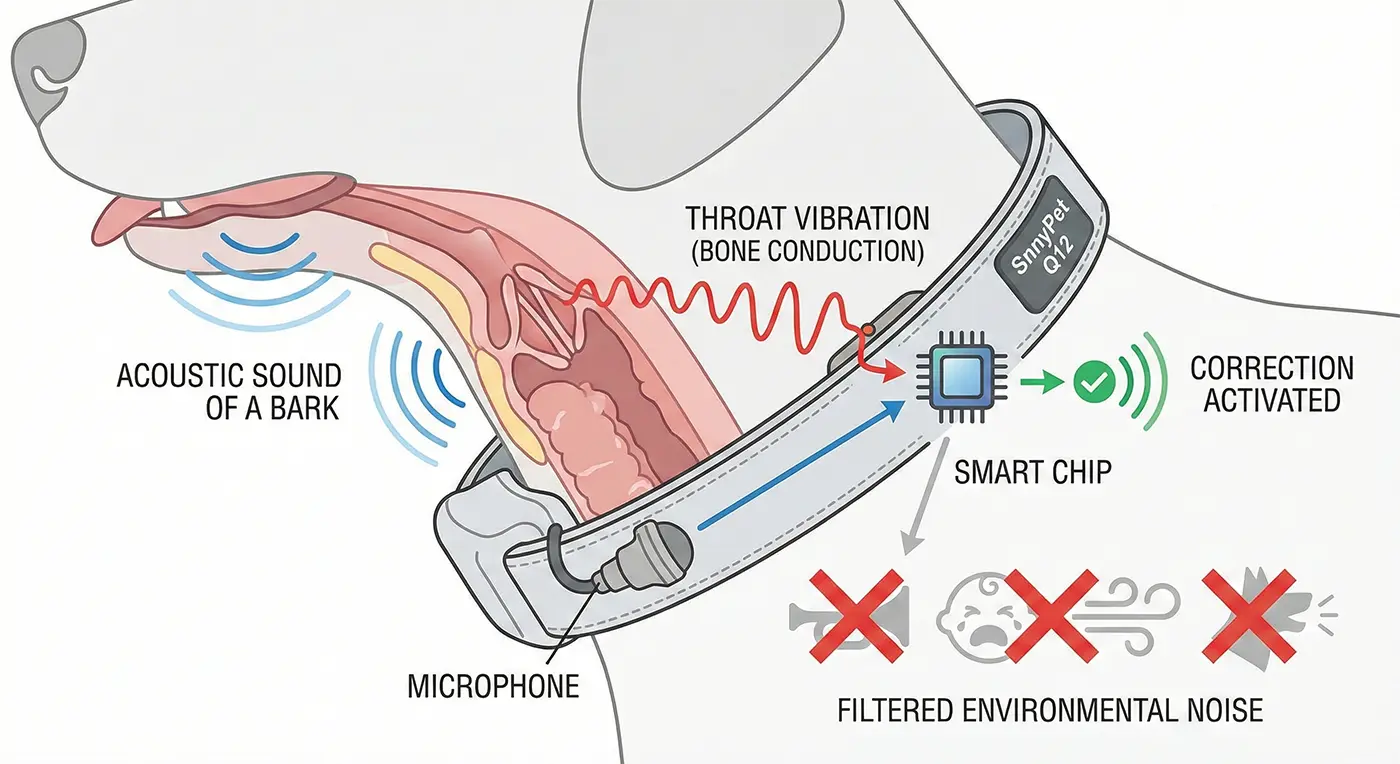
Can I adjust the sensitivity of the bark detection on the SnnyPet Q12?
Yes, there are 8 sensitivity levels that can be adjusted directly on the device by short-pressing the power button. Level 1 requires a very strong bark to trigger, while Level 8 is highly sensitive and can capture quiet woofs or whines.
What are the 4 training modes available on the SnnyPet Q12?
The Q12 offers: Beep Only (warning tone), Vibration Only (haptic feedback), Beep + Vibration (standard combo), and Beep + Dual Vibration (progressive intensity for persistent barking).
Which training mode should I choose for my dog's temperament?
Start with Beep Only for sensitive dogs. Use Beep + Vibration as the standard mode for most training. You can fine-tune the intensity within each mode using the 8 sensitivity levels to find the perfect match for your pet.
Why is there a 12-hour maximum wear time for the SnnyPet Q12?
Exceeding 12 hours can cause skin irritation or pressure sores due to constant physical pressure on the neck area. This risk exists regardless of the material’s gentleness, so it’s critical to give the skin a break
What is the recommended daily schedule for wearing the Q12?
Put the collar on during active periods and remove it at night. Ensure the total wear time does not exceed 12 hours. Rotate the device’s position slightly every few hours to prevent constant pressure on a single spot of the neck.
Is it normal if my dog flinches or seems anxious when the SnnyPet Q12 vibrates for the first time?
Yes, a startle response for the first 1-3 times is normal because dogs aren’t used to feeling buzzing on their neck. This doesn’t mean it hurts; they are simply surprised by the new sensation.
How do I desensitize my dog to the SnnyPet Q12 if they are sensitive to vibration?
Let them wear the collar powered OFF for 2-3 days first to get used to the weight. Then, activate the lowest vibration level and immediately give them a high-value treat to build a positive association (Buzz = Treat).
Will the SnnyPet Q12 stop my dog from barking completely?
No, and that isn’t the goal. The Q12 is a training tool, not a muzzle. It reduces nuisance barking (boredom, attention-seeking) by interrupting the cycle, allowing you to redirect them to desired behaviors.
What are the realistic outcomes I should expect from using a bark collar like the Q12?
Expect reduced excessive barking and a faster learning curve for the “quiet” command when paired with positive reinforcement. However, the collar does not address root causes like anxiety, which require separate behavior modification.
How do I ensure the highest success rate when first introducing the SnnyPet Q12?
Follow the “Off-Mode First” rule. Letting your dog wear the Q12 while it’s turned off for 3 days prevents them from becoming “collar-wise” (only behaving when they feel the weight). Pair this with high-value treats to make the collar’s presence a positive event before any corrections start.
How does the Q12's detection technology prevent accidental triggers from other sounds?
The Q12 uses advanced sound and vibration recognition technology that filters out most outside noises (like thunder or other dogs). It is specifically calibrated to trigger only when it detects the unique combination of your dog’s barking decibels and neck vibration.
What happens if I forget to remove the Q12 collar at night?
Leaving the collar on for more than 12 hours can lead to skin irritation or pressure sores due to constant physical pressure on the neck. This is not caused by electricity, but by the device itself pressing on the same spot for too long. Always remove the collar during sleep.
Can a laser toy cause long-term harm to my cat's behavior?
Only if used incorrectly. Automatic lasers can lead to obsession because the cat never “wins.” By using the ZY-245’s manual control (via the iCam 365 app) and always ending the game by pointing the laser at a physical toy or treat, you allow the cat to complete their prey cycle, keeping them mentally healthy.
Does the geofence still work if my phone is off or has no battery?
The fence logic is processed by the G761 device and the cloud servers, not your phone. As long as the G761 has battery and a network signal, the system will continue to monitor the boundary. Once you turn your phone back on or log in from another device using the Tlife app, you will see the alarm notifications.
When should I use the "Beep + Dual Vibration" mode on the Q12?
This mode is designed for persistent barking where standard vibration is ignored. It uses a progressive sequence to increase the sensory distraction, encouraging the dog to break their focus on whatever they are barking at. Always start with lower modes before escalating.
What is the best background noise to help an anxious dog during fireworks?
White noise or classical music with heavy bass is more effective than the TV. The low frequencies help drown out the sharp “booms” of fireworks or thunder, creating a more consistent and calming sonic environment for your pet.
What is the number one reason bark collars fail to produce results?
Lack of follow-through from the owner. The collar provides the “pause,” but the owner must provide the “redirection.” If you don’t reward the quiet behavior that follows the vibration, the dog won’t learn what you want them to do, only what you don’t want.
How to stop a dog from barking without using static shock?
Progressive “Interruption Training” uses vibration and sound patterns to break the barking cycle. Devices like the Q12 audit the bark’s vibration to avoid false triggers, ensuring humane behavior correction.
What is the ideal feeding schedule for a cat with separation anxiety?
Frequent “micro-meals” (6-8 times a day) can keep a cat engaged and reduce anxiety-linked behaviors. Using a programmable AI feeder like the ZY-245 allows for precise, remote scheduling of these sessions.
How long should a pet tracker's battery realistically last?
In “Power Audit” mode (periodic updates), high-quality trackers last 10-15 days. In “Real-Time Sprint” mode, they last 2-3 days. The G761 is optimized to balance these modes for maximum hardware longevity.
Can remote laser play features provide enough exercise for indoor pets?
It is an excellent supplement for indoor activity. Using an automated AI schedule, such as the one in the ZY-245, provides consistent exercise sessions to prevent weight-creep while you are away.
How to set up an effective "Virtual Safe Zone" (Geofence)?
Set the radius to at least 50 meters to avoid false alarms from minor satellite fluctuations. The G761 allows you to audit and customize these zones for reliable escape-artist prevention.
Why is my smart collar's audio sensor triggering when my other dog barks?
This is a “Sensor Audit” issue. Look for professional collars like the Q12 that use dual-sensing technology (sound + throat vibration) to isolate and correct only the wearer’s barking.
How to introduce a pet to an automatic feeder without causing anxiety?
Start by using the “Manual Dispense” button while present, offering high-value treats to associate the machine’s sound with a positive audit. The quiet operation of the ZY-245 helps speed up this adjustment.
What is the "Cold Start" vs. "Warm Start" time for a pet GPS?
Engineering Audit: A Cold Start (first signal) takes longer as the device downloads satellite data. The G761 is optimized for rapid re-acquisition, ensuring a faster Warm Start once the pet moves from indoors to outdoors.
Can I record a custom voice message for my pet's mealtime?
Auditory conditioning: Yes, the ZY-245 allows you to record a voice clip that plays during food dispensing, using your familiar voice to reinforce positive feeding behavior remotely.
How do I audit the "Sensitivity Levels" on a humane bark collar?
Every dog has a different bark frequency. The Q12 provides adjustable sensitivity (Levels 1-8). We recommend Level 5 for standard environments to audit and filter out non-target noise effectively.
How often should the AI feeder's internal mechanisms be cleaned?
Hygiene audit: To prevent kibble dust buildup and ensure sensor accuracy, we recommend a deep clean of the ZY-245 tank and tray every 2-4 weeks using only mild soap and water.
Can I audit my dog's "Historical Routes" from a month ago?
Data Audit: Yes, professional trackers like the G761 store historical movement patterns, allowing you to review past exercise routes and territory habits over time through the app.
How to manage "Multi-User Access" for pet monitoring?
Security audit: Devices like the ZY-245 allow primary owners to share access with family members via the iCam 365 app, ensuring the entire household can participate in the pet’s health and feeding audit.
Is it safe to use a bark collar during high-intensity play with other dogs?
Safety Audit: High-intensity play often involves excited barking. For the pet’s comfort, we recommend removing the Q12 in these environments to avoid confusing corrective feedback during positive social interaction.
How does the AI feeder prevent food from jamming?
Mechanical Audit: The ZY-245 uses a specialized internal impeller and torque sensors. If a jam is detected, the system audits the resistance and can reverse or adjust to ensure consistent dispensing of dry kibble.
Do I need to update the firmware on my pet safety devices?
Yes. Periodic firmware audits ensure your devices like the G761 receive the latest satellite protocol optimizations and security patches to maintain peak hardware performance.
How to customize "Instant Alerts" for pet escapes?
Notification Audit: In the app for the G761, you can set push notification priorities for Geofence breaches, ensuring you receive a high-priority audit the moment your pet leaves a designated safe zone.
Are the stainless steel bowl and inserts of the ZY-245 dishwasher safe?
Yes. The SnnyPet ZY-245 stainless steel plate and the slow feeder insert are fully dishwasher safe (top rack recommended). However, never put the main unit, food hopper, or lid in the dishwasher; these parts should only be wiped clean with a damp cloth to protect the electronics.
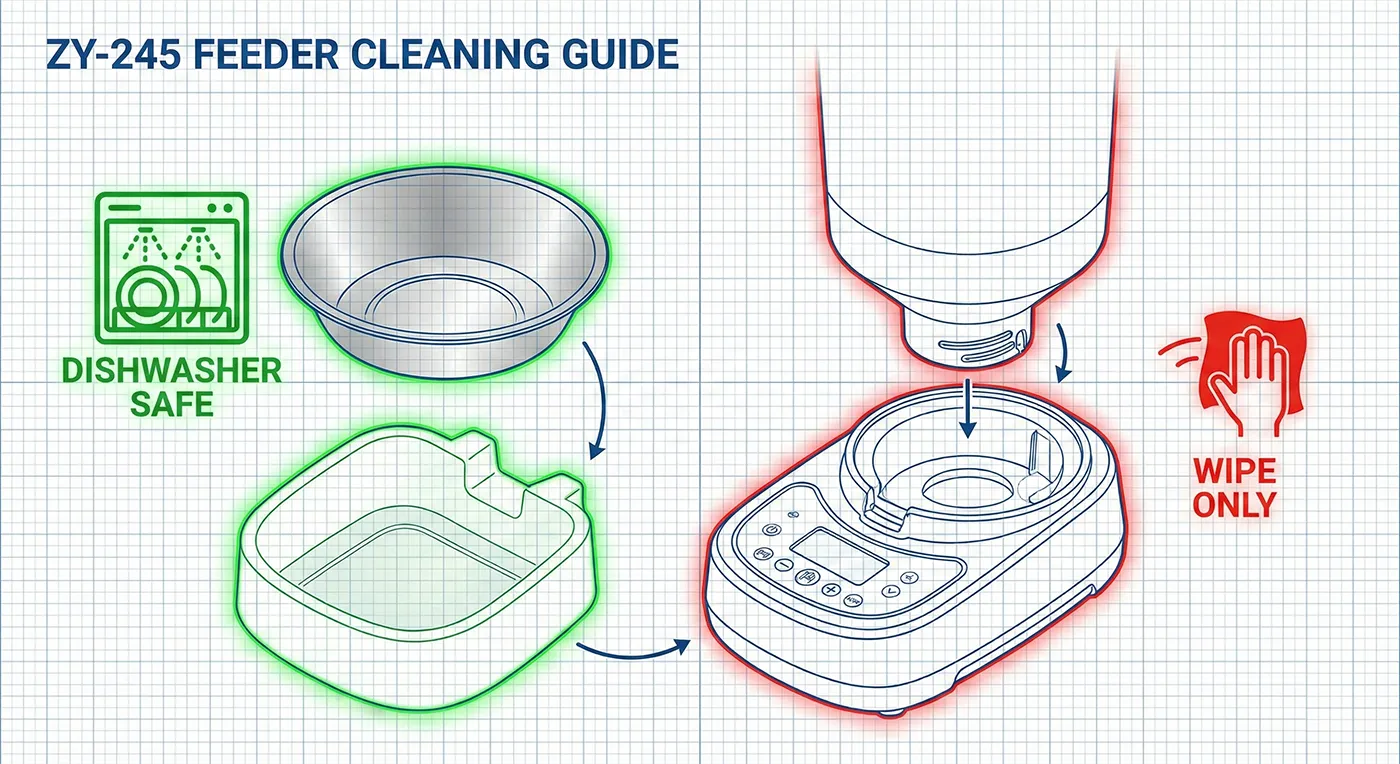
Comprehensive maintenance guide for the SnnyPet ZY-245: Removable feeding components are dishwasher safe for hygiene, while the electronic base must only be wiped with a damp cloth to prevent damage.
How often should I clean the SnnyPet bowl to prevent bacteria buildup?
To prevent biofilm buildup (a slimy layer of bacteria), we recommend washing the stainless steel bowl every 3-4 days. For a complete deep clean, empty the hopper every 2 weeks and wipe the interior with a pet-safe disinfectant to ensure the food remains fresh and uncontaminated.
Why is the motor running but no food is coming out of my ZY-245?
This is usually caused by a rotor blockage. Unplug the device, remove the hopper, and check for kibble pieces or food dust hardened between the rotor blades. Ensure the dispensing mechanism can move freely by rotating it manually with your hand before restarting.
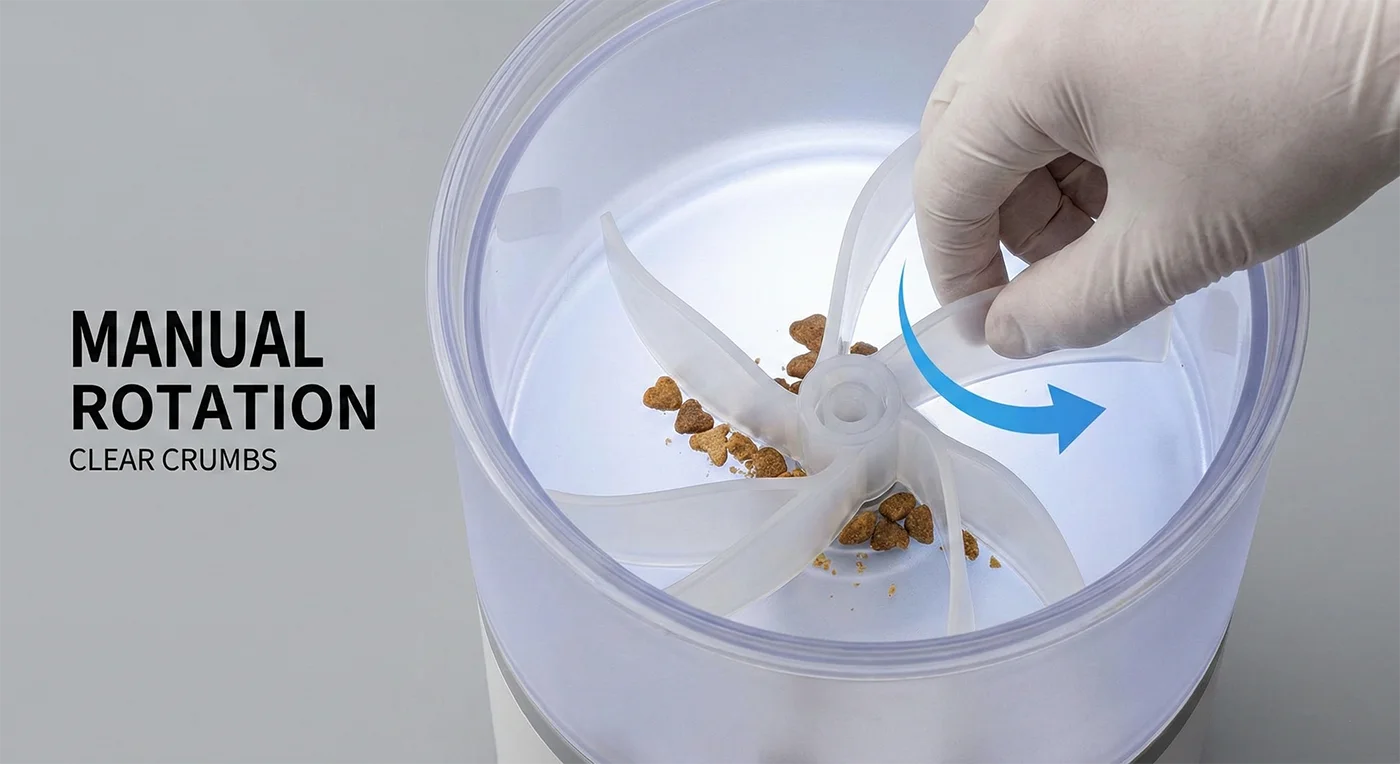
How can I prevent the "rotor blocked" error on my SnnyPet feeder?
Prevention is key: only use dry kibble between 5-15mm in diameter. Avoid moist, irregularly shaped, or sticky semi-moist foods, as these are the primary causes of jams. Also, empty and clean the hopper monthly to prevent old food dust from accumulating.
Why is my SnnyPet ZY-245 constantly disconnecting from Wi-Fi?
The ZY-245 requires a stable 2.4GHz Wi-Fi connection. If your router uses a combined 2.4GHz/5GHz SSID, the device may drop offline. We recommend using a dedicated 2.4GHz channel and ensuring the feeder is placed within 30 feet of the router with minimal obstructions.
What causes the SnnyPet camera feed to buffer or go offline?
Physical obstacles like concrete walls or appliances can degrade the signal. If the indicator light on the device is not solid blue, it means the connection is lost. Try a full power cycle of both your router and the feeder (unplug for 10 seconds).
The laser on my ZY-245 won't turn on—is it broken?
Open the iCam 365 app, enter the live view, and use the PTZ/Directional control to activate the laser. Ensure your app has the latest firmware update, as settings can sometimes be reset.
Why did the laser stop working after a few minutes of play?
For safety, avoid continuous laser use for extended periods. If the laser stops, close the iCam 365 app and wait 5 minutes for the unit to cool down. If it still doesn’t work after a rest, please contact our support team.
Why is the portion size inconsistent on my SnnyPet ZY-245?
Like most smart feeders, the ZY-245 measures by volume (rotor rotations), not by weight. Variations in kibble size, shape, and density can lead to a normal variance of ±2g per serving.
How do I fix the portion weight after switching pet food brands?
Whenever you change kibble, we recommend using a kitchen scale to weigh one dispensed serving. You can then adjust the number of portions in your scheduled feeding plan to ensure your pet gets the exact amount of calories required.
What should I do if the iCam 365 app crashes or freezes?
Force-close and reopen the app, then check the App Store or Google Play for an iCam 365 update. If the issue persists, try clearing the app cache or reinstalling the application.
Is there a known issue with the iCam 365 app on Android 14?
Some Android 14 users may need to manually enable “Background Data Usage” and “Battery Optimization: Unrestricted” for the iCam 365 app to ensure stable real-time notifications and connectivity.
Why am I getting false exit alerts when my dog is inside the house?
This is caused by GPS drift. Indoors, GPS signals can reflect off walls and “jump.” Since the G761 has an outdoor accuracy of 5-10m, we recommend setting your Tlife app fence buffer slightly wider or removing the collar when indoors to prevent “phantom alerts.”
How can I reduce false triggers on my G761 virtual fence?
Ensure the G761 antenna is positioned on the back of the neck, facing upward for optimal satellite reception. Also, simplify your fence shape by avoiding sharp angles; smooth polygons are less prone to calculation errors.
My G761 is flashing lights—why can't it find a signal?
According to the manual, a Green Light single flash means the device is searching for GPS satellites, while a Blue Light single flash means it’s searching for a network signal. Move to an open field away from tall buildings or metal structures to help the device get a “fix” faster.
What if my G761 cannot get a location even after 30 minutes outside?
Perform a hard restart by holding the power button for 10 seconds. Note that a “cold fix” during first-time setup can naturally take 3-5 minutes as the device maps the constellation. If it still fails, the GPS module may need replacement.
Why is the G761 battery draining so quickly?
Battery life depends on your update frequency. In the Tlife app, check if you are in Normal Mode (1-min updates), which consumes the most power. For longer battery life, switch to Power Saving (60-min updates). Actual battery life varies based on your pet’s activity and signal strength.
Why does the G761 drain its battery overnight despite a full charge?
Cold weather (below 32°F/0°C) can reduce lithium battery performance. Also, if the tracker is in a basement or area with weak cellular signal, the device will use more power trying to stay connected. Ensure the device is powered off or in a good signal area when not in use.
Why does the map show my dog in the neighbor's yard?
Standard GPS has an accuracy margin of 5-15 meters. In dense neighborhoods, buildings and trees can reflect signals (multipath error), causing the map pin to shift slightly. This is normal for consumer-grade GPS technology.
How do I get the most accurate real-time location on the map?
If your device is in Power Saving mode, the position shown may be from up to 60 minutes ago. You can refresh the location at any time within the Tlife app. Note that indoors, the G761 will switch to Wi-Fi or LBS positioning, which has a larger error margin than outdoor GPS.
The SnnyPet Q12 is not responding to barking—is it broken?
The most common cause is a loose fit. The Q12’s vibration device must be in close contact with the skin. According to the manual, you should only be able to fit one finger between the strap and the neck. For thick-coated dogs, ensure the device is centered on the throat and the hair is parted to allow the unit to sit snugly.
Why doesn't the SnnyPet Q12 pick up my dog's quiet barks?
Check your sensitivity setting (Levels 1-8). For quiet barks, try Level 5 or higher. Also, note the safety feature: if triggered 6 times consecutively, the Q12 will stop working for 1 minute to protect your pet before resuming automatically.
Why does the SnnyPet Q12 activate randomly while my dog is playing?
If the collar is too loose, the device box may slide and bounce against the dog’s neck, which the internal sensor might misinterpret as a bark. Tightening the collar to the “one-finger” standard will resolve most random triggers.
Why does the SnnyPet Q12 go off when my dog is eating or drinking?
Strong swallowing movements can sometimes be detected by the high-sensitivity sensors. If this occurs, try lowering the sensitivity level in the app or slightly adjusting the position of the device on the neck.
My Q12 is plugged in but there is no light—what should I do?
Moisture is enemy #1. Ensure the charging port is completely dry before connecting. Use compressed air or let it air-dry for an hour after water exposure. If it was deeply discharged to 0%, it may take 5-10 minutes before the LED shows it is charging.
My SnnyPet Q12 is not charging properly.
Ensure you are using a 5V output charger only. Chargers with 9V or 12V output will damage the device. Check the USB charging port for any debris and ensure the cable is firmly plugged in. The battery icon will indicate charging status.
The SnnyPet Q12 stopped working after 3 months—can I get a replacement?
SnnyPet offers a 1-year warranty on manufacturing defects. Before filing a claim, try a hard reset by holding the power button for 15 seconds. Note that physical damage from chewing or saltwater corrosion voids the warranty.
Why did my Q12 suddenly stop mid-use?
Check your charger and power source first, as some wall bricks are incompatible. Lithium batteries typically last 300-500 cycles (1-2 years); if your device is over a year old, a battery replacement service is available.
Why did the Q12 leave red marks on my dog's neck?
Irritation is caused by constant physical pressure and moisture, not the vibration itself. Follow the 12-hour max rule—never wear the collar 24/7 and remove it every night to let the skin breathe.
How can I prevent skin irritation under the SnnyPet Q12 receiver?
Rotate the collar’s position every few hours to vary the pressure points. Ensure the neck area is clean and dry. Most importantly, do not wear the device for more than 12 hours per day.
What is the best way to clean my pet's smart electronics?
Never submerge electronics in water. Use a damp microfiber cloth with mild soap for plastic housings, and dry immediately. For sensors and camera lenses, use only a dry microfiber cloth or a specialized lens wipe to avoid scratching.
Can I use Clorox wipes or alcohol on my pet feeder?
You can use 70% isopropyl alcohol on hard, non-porous surfaces like plastic and metal, but avoid rubber seals. If the hopper has mold, wash it with soap and water, then let it air-dry for 24 hours; a cycle with baking soda can help absorb any lingering odors.
My dog chewed the charging cord—does the warranty cover this?
No. Pet damage is considered accidental, not a manufacturing defect, and is not covered by the standard warranty. You can purchase replacement straps, cables, and sleeves in the “Spare Parts” section of our website.
Can I tape up a chewed cord to keep using the feeder?
Unplug it immediately. Do not attempt to repair an electrical cord with tape; it poses a fire and shock hazard. Replace the cord entirely and use a bitter apple spray or cord hider to prevent future chewing.
What is the number one cause of device failure for SnnyPet?
Moisture in the charging port. Whether it’s the G761 tracker or Q12 collar, the port must be completely dry before connecting to power. This simple step prevents short circuits and extends your device’s life by years.
How do I ensure the SnnyPet ZY-245 dispenses the correct amount of food?
The ZY-245 dispenses food based on volume (“portions”). To ensure accuracy, use dry kibble sized between 5-15mm. For a new food brand, we recommend weighing the first few manual portions to determine how many “portions” equal your pet’s required gram weight.
What is the best shape for a G761 geofence?
Smooth polygons. Avoid sharp angles or “star” shapes, as these create calculation errors in the GPS logic. A simple rectangle or smooth multi-sided shape provides the most stable boundary detection.
The device is unresponsive—how do I force a reset?
For the SnnyPet Q12 or G761, long-press the power button to restart. For the SnnyPet ZY-245, open the lid and hold the WiFi Reset button for 4 seconds until the indicator flashes blue to re-enter pairing mode.
Is it okay to let my dog swim in the ocean with the G761?
Yes, but saltwater is highly corrosive. You must rinse the device thoroughly with fresh water immediately after leaving the beach and dry the magnetic contact points to prevent permanent damage to the charging port.
Why is the G761/Q12 charging so slowly?
Some high-wattage wall bricks (2A+) can trip the device’s internal protection circuits. Try charging from a computer USB port or a lower-amperage (500mA-1A) adapter for a more stable and safe charge.
Why does my dog bark at an empty hallway or stare at a wall and bark?
- Dogs aren’t barking at “nothing”; they perceive stimuli humans cannot. With a hearing range up to 60 kHz (compared to 20 kHz in humans), your dog may be alerting to high-frequency hums from electronics, distant traffic, or even rodents moving inside the walls.
Is nighttime barking in senior dogs a sign of a medical issue?
It can be. Senior dogs may suffer from Canine Cognitive Dysfunction (CCD), similar to dementia, which causes confusion and distress during the night. If the barking is accompanied by pacing or staring into space, a veterinary check-up is recommended.
How do I stop my dog from barking just to get my attention?
Attention-seeking barking is a learned behavior. The best approach is to ignore the barking entirely and only reward them when they are quiet. Humane tools like the SnnyPet Q12 can help interrupt these cycles, but must be paired with positive reinforcement to be effective.
Why does my dog jump on guests or knock people over in excitement?
Jumping is a natural greeting behavior where dogs attempt to reach human faces. Pushing them down often backfires as it provides the physical touch and attention the dog is seeking, effectively rewarding the behavior.
What is the most effective way to teach polite greetings and stop jumping?
Use the “four-on-the-floor” protocol: immediately turn away and remove all attention (no eye contact, no touch) when they jump. Only praise and pet your dog the instant all four paws stay on the ground.
Should I comfort my dog during fireworks, or will it "reward" their fear?
Yes, you should comfort them; the myth that cuddling “rewards fear” has been debunked. You cannot reinforce an emotion like fear with affection; your calm presence provides essential reassurance.
How can I create a safe space for a dog with severe noise phobia?
Provide a covered crate in a windowless interior room and use white noise or classical music to mask external booms. Using a Thunder Shirt can also provide calming pressure for many anxious pets
What should I do if my dog becomes self-destructive during thunderstorms?
In severe cases, behavioral modification may not be enough. Consult your veterinarian about anti-anxiety medications (like trazodone) to help manage predictable high-stress events.
Why does my dog drag me on walks and pull on the leash constantly?
Leash pulling is self-rewarding: the dog learns that pulling gets them to interesting smells faster. Avoid choke chains or prong collars, as they risk injury and rarely solve the underlying behavior.
What are the best force-free methods to stop leash pulling?
Try the “Stop-and-Go” method: the second the leash tightens, stop walking immediately and only resume when the dog creates slack. Alternatively, reverse direction whenever they lunge ahead to teach them to watch you.
Is a no-pull harness better than a standard collar for large dogs?
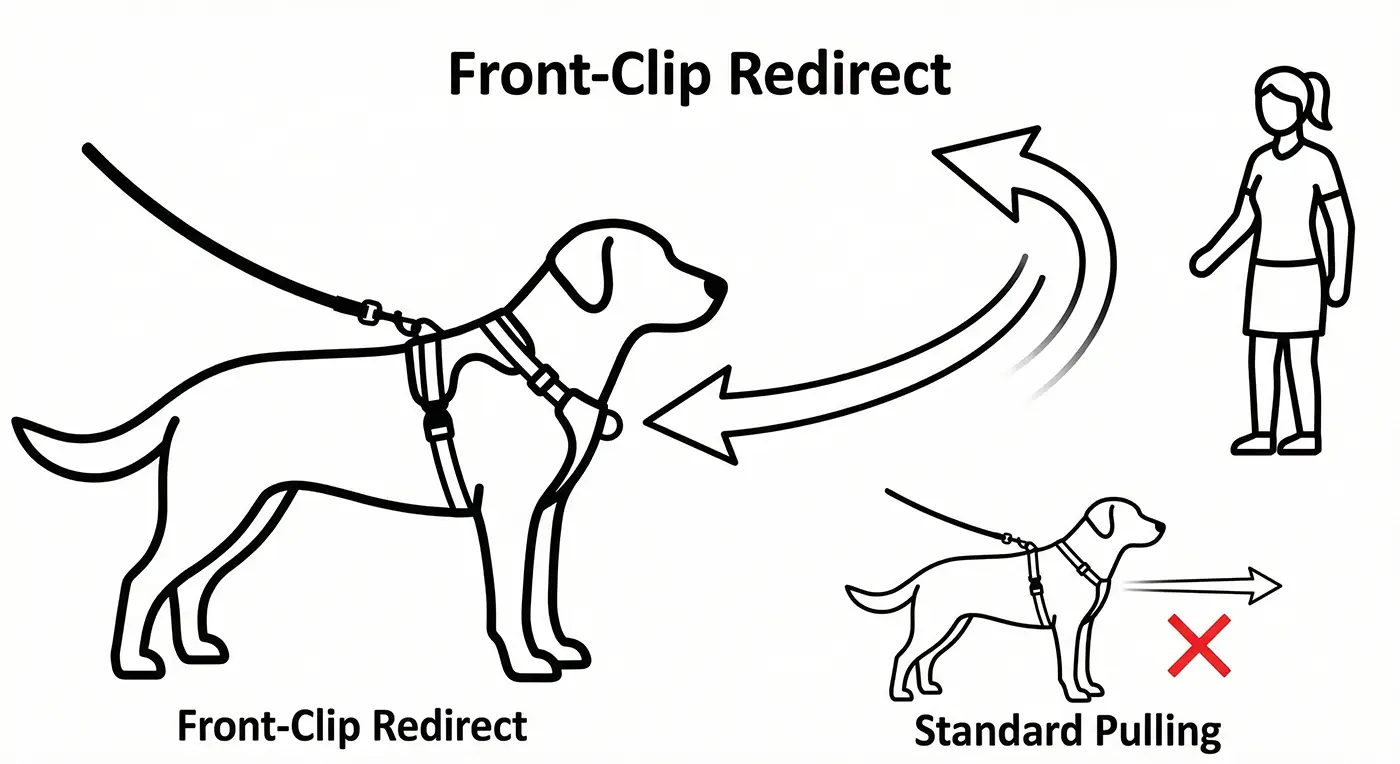
Yes, a front-clip harness is highly effective because it physically redirects the dog toward you when they pull. This humane tool discourages pulling without causing pain or airway restriction.
How can I tell if my dog's indoor accidents are due to a medical issue or poor training?
Sudden regression in an adult dog is often a red flag for medical conditions like a UTI, diabetes, or kidney disease. If the dog sniffs and circles before urinating, it’s likely a training issue; if they strain or produce bloody urine, visit a vet immediately.
What is the difference between territorial marking and submissive urination?
Marking usually involves small amounts on vertical surfaces and is common in intact males. Submissive urination occurs during greetings or scolding; in these cases, you should build the dog’s confidence and avoid all punishment.
Should I scold my dog if I find an accident they left hours ago?
No. Dogs cannot connect punishment to an event that happened in the past. Rubbing their nose in it only creates fear and destroys trust without teaching them where the correct potty spot is.
What is the safest timeline for introducing a new dog to a resident cat?
A successful introduction typically takes 2-4 weeks. Start with total separation and scent swapping for the first week, followed by visual contact through a baby gate where both pets are rewarded for calm behavior .
What are the biggest mistakes when introducing dogs and cats?
Never hold the cat and let the dog approach, as the cat will feel trapped and may strike out. Also, do not leave them unsupervised for at least the first 30 days until their relationship is fully stable.
Is my cat being spiteful when she knocks glasses or plants off the counter?
Cats don’t understand spite; they knock things over due to prey instinct (mimicking pawing at prey) or simply to get your attention . If you yell or chase them, they learn that “knocking = owner entertainment”.
How can I redirect my cat’s energy away from my valuables?
Ignore the behavior—clean up silently with zero reaction. To provide a better outlet, use interactive tools like the SnnyPet ZY-245 remote laser to satisfy their hunting drive in a controlled way.
Is declawing a humane way to protect my sofa from cat scratching?
No. Declawing is a painful amputation of the last toe joint, not a simple nail trim. It is banned in many countries and can lead to long-term physical and behavioral issues.
Why does my cat ignore the scratching post and use the carpet instead?
Cats scratch to mark territory; place the post directly next to the furniture they are currently damaging, not in a hidden corner. Also, experiment with different materials like sisal rope, cardboard, or carpet to find their specific preference.
Why does my cat bring me dead mice or birds as "gifts"?
Your cat isn’t giving you a gift; they think you are a terrible hunter and are trying to provide for you. This is remedial hunting behavior where they treat you as part of their colony.
How should I respond to a dead "gift" without hurting my cat's feelings?
Stay calm and praise them briefly, then dispose of the animal discreetly. To reduce hunting, keep your cat indoors during dawn and dusk prime hunting hours and use a collar bell.
How often should I bathe my dog to keep them smelling fresh?
Most dogs only need a bath every 4-8 weeks. Short-coated breeds like Beagles can go 6-8 weeks, while double-coated breeds like Huskies only need bathing every 8-12 weeks to avoid damaging their natural oils.
Can too much bathing cause dry skin or allergies in dogs?
Yes. Over-bathing strips the skin of essential oils, leading to irritation and dryness. Always use a pet-specific shampoo, as human products have the wrong pH balance and can cause dermatitis.
How can I trim dog nails if they are terrified of the clippers?
Don’t force it; desensitization is key. Spend a week just touching their paws with the clipper nearby while giving treats, and only aim to trim one nail per session once they are comfortable .
🐾 Pro Tips for Safe Nail Trimming
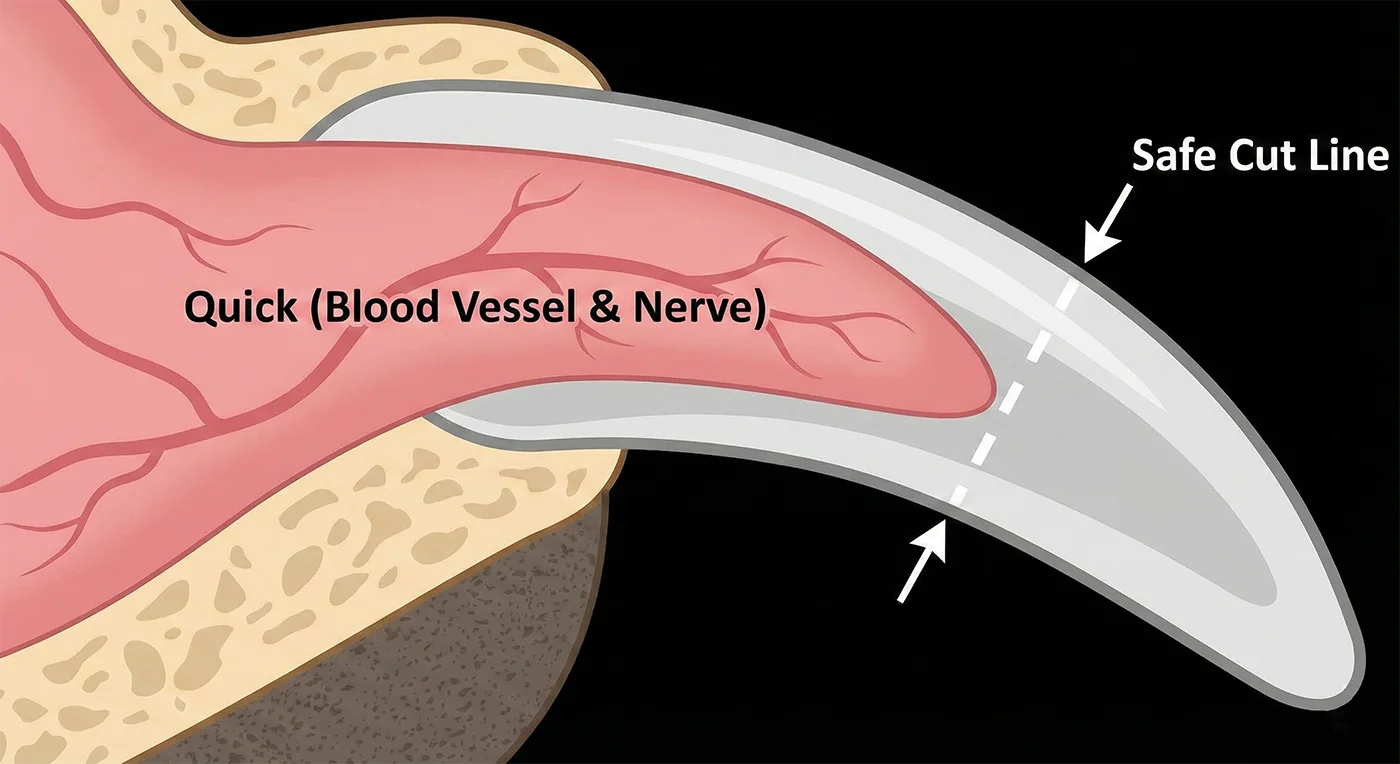
For Light-Colored Nails (Visible Quick): Follow the diagram and maintain a distance of at least 2mm from the pink area (the quick). Make a clean, swift cut to avoid crushing the nail.
For Black Nails (The Invisible Challenge):
Incremental Trimming: Cut only 1-2mm at a time. Never try to trim the entire length in one go.
Inspect the Cross-Section: Check the cut surface after each snip. If the center looks dry, chalky, or solid white, it is safe to continue.
Watch for the “Dark Dot”: As you get closer to the quick, a small, dark, and slightly moist-looking circle will appear in the center (it looks like a tiny pupil). STOP IMMEDIATELY! This is the beginning of the blood vessel. One more millimeter and your pet will experience pain and bleeding.
Emergency Preparedness: No matter how experienced you are, always keep a bottle of Styptic Powder within reach. Accidents happen, and being prepared ensures your pet’s comfort and safety.
What should I do if I accidentally cut the quick and the nail starts bleeding?
Stay calm—your panic will make the dog more fearful. Apply styptic powder, cornstarch, or flour with firm pressure to the tip of the nail to stop the bleeding.
Is excessive thirst in pets a sign of a serious medical condition?
Yes, increased drinking and urination are red flags for conditions like diabetes, kidney disease, or Cushing’s disease . If an older cat or middle-aged dog suddenly starts drinking significantly more, consult a vet immediately.
How much water is "too much" for a dog to drink daily?
A general rule of thumb is more than 100ml per kg of body weight per day (e.g., a 20kg dog drinking over 2L). When visiting the vet, bring a fresh urine sample (less than 12 hours old) to assist with the diagnosis.
Is it legal or safe to use a pet GPS tracker for a child or elderly relative?
While technically possible, using a pet tracker on a human is ethically and legally complex. Tracking another adult without their consent may violate privacy laws, and the device is physically bulky for small human wrists.
Can the G761 tracker be used as a medical alert or fall detection system?
No. The SnnyPet G761 is not FDA-approved as a medical device. It should not be relied upon for critical health monitoring, as it lacks specialized features like fall detection or direct emergency services integration.
Can dogs hear electronics buzzing that humans cannot?
Yes. Household appliances like refrigerators or routers emit high-frequency sounds up to 40-60 kHz. While silent to us, these noises can be intrusive or startling to dogs, causing them to bark at what appears to be “nothing”.
Why is human shampoo bad for a dog's skin?
Dogs have a different skin pH level than humans; human shampoo is too acidic and can damage the dog’s acid mantle (protective layer). This leads to dryness, irritation, and an increased risk of fungal or bacterial infections.
What if I don't have styptic powder after cutting a nail too short?
In an emergency, you can use common household items like cornstarch or flour. Apply a thick layer with pressure to the bleeding nail tip and keep the dog still for 5 minutes until a clot forms.
How do I collect a urine sample from my pet for the vet?
Use a clean, dry container to catch the mid-stream urine during their first walk of the day. The sample must be refrigerated and delivered to the vet within 12 hours to ensure the results are accurate.
Why does my cat bring me live animals instead of dead ones?
This is an “advanced” hunting lesson. Mother cats bring live prey to their kittens so they can practice the “kill bite” themselves; your cat is trying to give you the same remedial training.
Why does my SnnyPet camera take longer to load on Android 14?
There is a known compatibility issue with Android 14’s background data management and the current app version. We are currently beta-testing a fix to ensure smoother real-time streaming for all Android users.
Can activity trackers detect early signs of arthritis in senior dogs?
By auditing daily activity trends, devices like the G761 allow owners to monitor mobility levels. A consistent decrease in “Active Minutes” can be a prompt for a veterinary check-up.
How is AI changing the way we monitor pet health and behavior?
AI “audits” behavior patterns. For instance, the ZY-245 monitors feeding habits, allowing you to detect anomalies in eating behavior that standard feeders might miss.
Why is the industry shifting toward "Buy-and-Own" pet technology?
Transparency is the driver. Many pet owners prefer upfront pricing over monthly fees. Our audit of products like the G761 prioritizes long-term value and honest hardware ownership.
What is the risk of "Over-Automation" in pet feeding?
Psychological audit: While AI feeders like the ZY-245 provide precision, owners should still maintain a human connection. Use the two-way audio and manual treat dispense features to ensure technology enhances, rather than replaces, your bond.
How does GPS technology impact a pet's sense of freedom?
Freedom Audit: GPS tracking like the G761 actually provides more freedom. It allows owners to grant pets more off-leash time in safe areas, knowing they have a 7-mode GNSS “safety net” to rely on.
Is "Sound Pollution" an issue with smart pet devices?
Acoustic Audit: Cheap devices can emit high-frequency coil whine. Professional hardware like the ZY-245 is audited for silent operation to ensure the device doesn’t disturb a pet’s sensitive auditory range.
How to audit "Wearable Ergonomics" for long-term comfort?
Neck Health Audit: Always check the weight-to-size ratio. The Q12 uses a lightweight, curved design to minimize pressure on the trachea, a standard essential for micro-breeds like Chihuahuas or Yorkies.
What are the IoT security protocols for pet cameras?
Privacy Audit: Professional systems like the ZY-245 use end-to-end encryption for video streams. Always avoid cameras without clear security documentation to prevent unauthorized visual access to your home.
The evolution of "Humane Training": Why is vibration winning?
Ethical Audit: Modern behaviorists prefer interruption over pain. The Q12 represents this shift by using vibration to interrupt obsessive barking, allowing the pet to learn through distraction rather than fear.
Understanding "Global Roaming" limitations for pet trackers.
Connectivity Audit: While the G761 uses global LTE-M/4G standards, always audit regional network coverage before travel to ensure continuous tracking service across international borders.
The future of "Behavioral AI" in pet care.
Intelligence Audit: The next frontier is predictive analytics. Current AI, like that in the ZY-245, is already auditing patterns to alert owners to habit changes, paving the way for truly proactive pet health management.